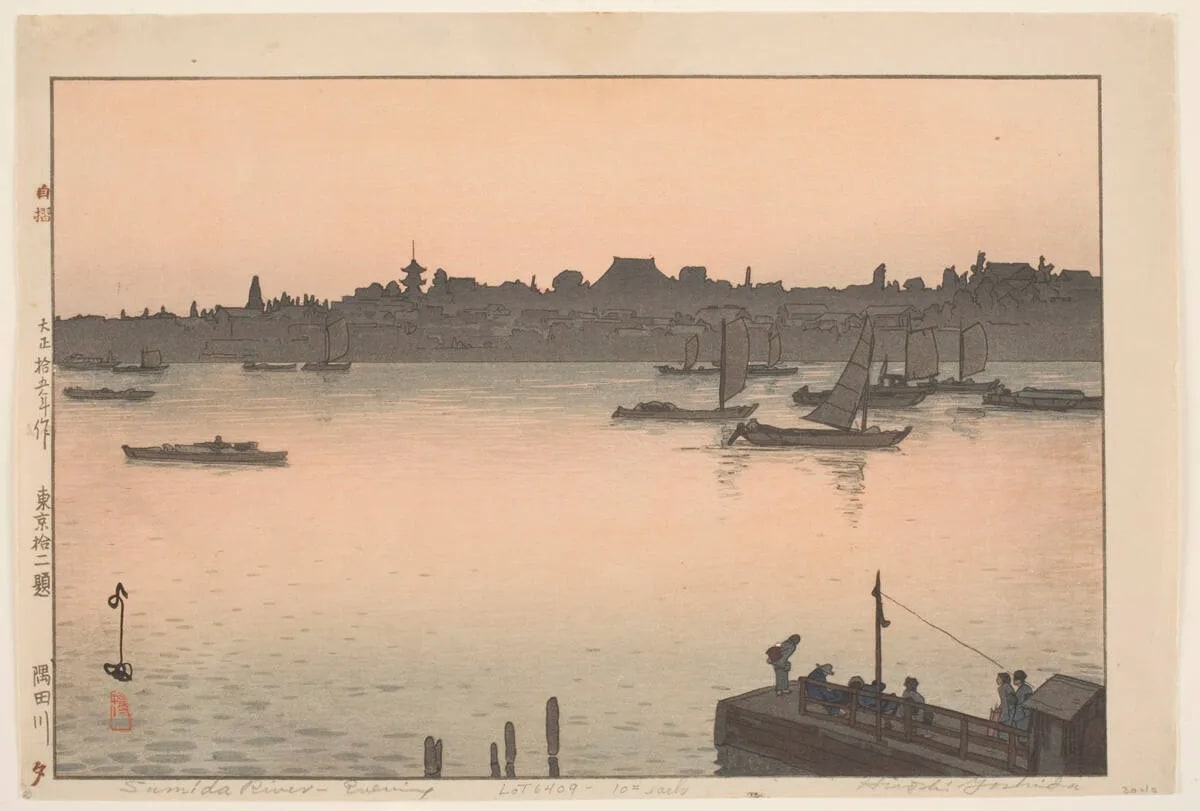
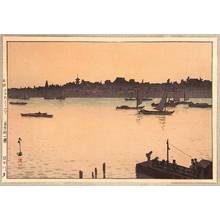
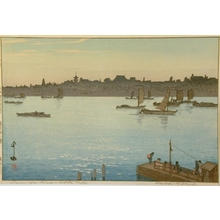
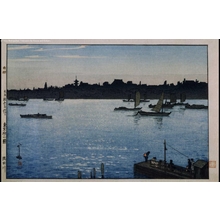
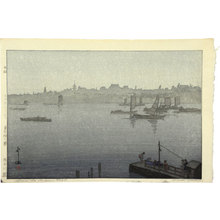
Yoshida Hiroshi创作的日本版画《Sumida River-Evening》
艺术家:Yoshida Hiroshi
标题:Sumida River-Evening
日期:1926
详情:更多信息...
来源:Worcester Art Museum
浏览所有3,039幅版画...
描述:
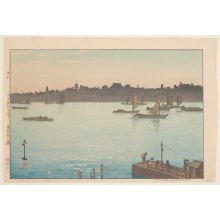
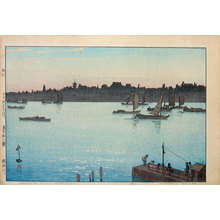
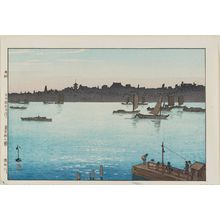
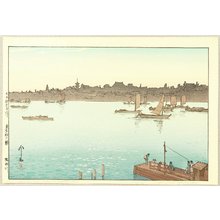
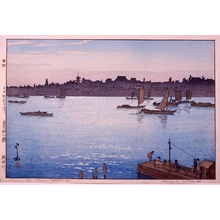
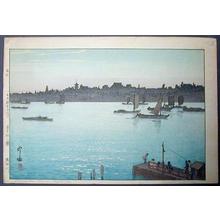
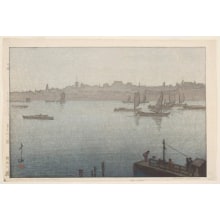
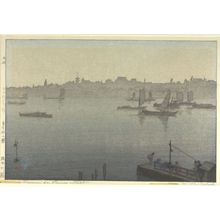
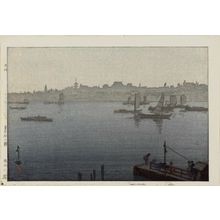
Here again it is by the expressive use of the printing technique-of applying pigment to paper with the barer-that the artist has created this evening view of the Sumida and one of its ferry stations. To viewers in 1926 the work provided a dramatic example of how, through color and lighting variations, an artist could affect perceptions of a given place. Using translucent washes of color to suggest the time of day when the sun is just below the horizon and its diffused light illuminates the coming night, Yoshida, printing from the same blocks he used in plates 37 and 38, has completely changed the mood of the design. There is no question that he was familiar with the works of Impressionist painters, particularly Claude Monet, who often depicted the same setting at various times of day. Yoshida had spent considerable time in the West. After studying oil painting in Kyoto and Tokyo, he traveled to America and Europe in 1899. From 1904 to 1906, he took a study tour throughout the United States-including a visit to the Louisiana Purchase International Exposition in St. Louis-Europe and North Africa. On his return to Japan, he built his reputation as an oil painter and watercolorist and did not turn to'printmaking until he was in his mid-forties. He traveled again to the United States after the 1923 earthquake. After he came back, he took up printmaking seriously. He mastered carving and printing skills and then, in 1925, opened his own workshop. Although Yoshida hired excellent carvers and printers to work under his supervision, he frequently cut the key blocks himself, mixed the colors, and printed the proofs to get the precise effects he wanted. And, as is evident in these Sumida River images, he continually experimented with technique in order to pursue his vision.
![Yoshida Hiroshi, 吉田博 (Yoshida Hiroshi)创作的日本版画《The Sumida river in mist [from the Twelve Views of Tokyo )Tokyo Juni-dai) series]》](https://data.ukiyo-e.org/mfa/thumbs/sc209094.jpg "The Sumida river in mist [from the Twelve Views of Tokyo )Tokyo Juni-dai) series]")