Utagawa Kunisada创作的日本版画《Iwai Hanshiro V Announcing His Return to the Edo Stage (Kudari zatsuki kojo)》
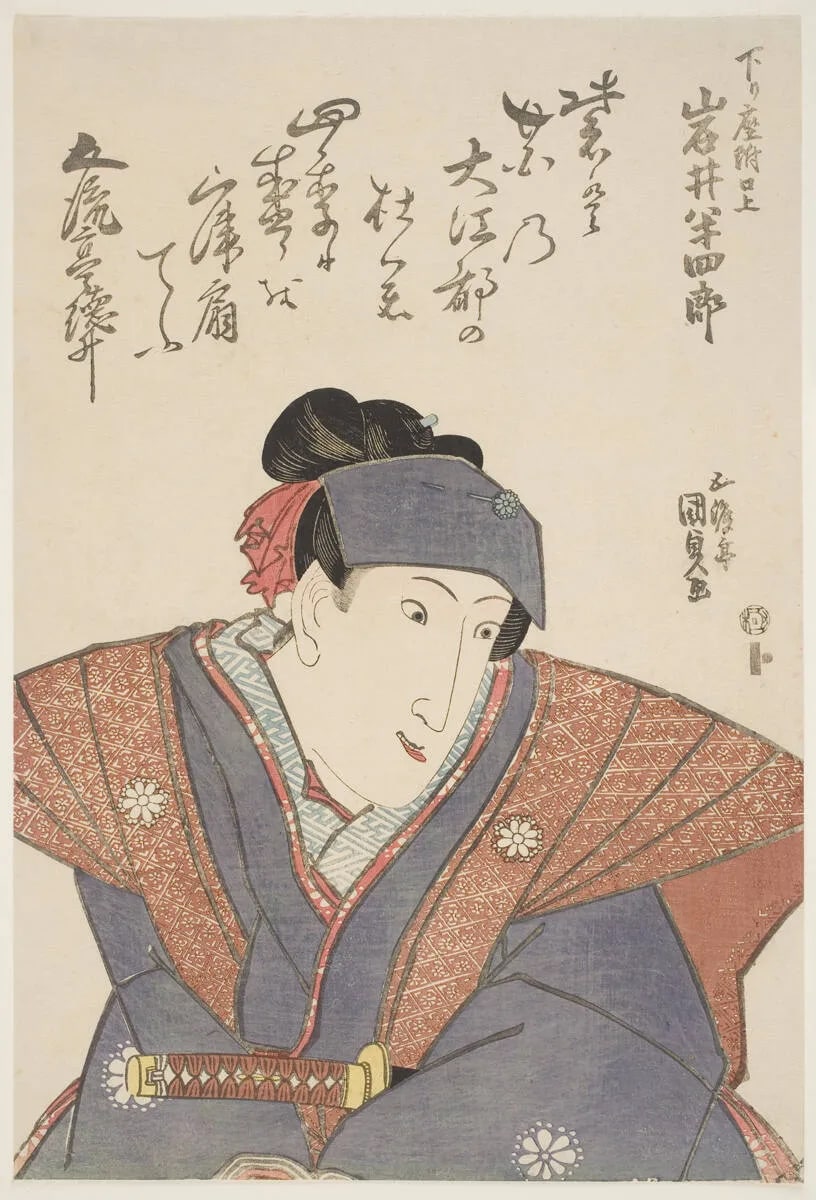
艺术家:Utagawa Kunisada
标题:Iwai Hanshiro V Announcing His Return to the Edo Stage (Kudari zatsuki kojo)
日期:late 1822
详情:更多信息...
来源:Worcester Art Museum
浏览所有3,039幅版画...
描述:
Kunisada's image of the great female impersonator Iwai Hanshiro V (1776-1847) portrays him in formal clothes making the official announcement of his return to the Edo stage in 1822. He is shown wearing a formal gray robe beneath a ceremonial stiff-shouldered garment (kataginu) woven with a small allover diamond pattern based on the Iwai family crest. The crest itself appears on the shoulds and on the sleeve of Hanshiro's kimono. Actors who specialized in playing women's roles were required to put on men's wigs at formal affairs, and they wore squares of purple silk to cover their shaven pates. Hanshiro's silk square is held in place by a silver pin, the head of which forms his crest. He wears a single sword through his sash. Under the strict social codes of the early Edo period, commoners were not allowed to carry swords. By the end of the Edo period, however, these codes had broken down and members of the lower orders such as merchants could carry one's sword, upon payment of a high fee. The poem by Goryutei Tokusho (1791-1851) celebrating Hanshiro's return reads: "Murasaki wa / hana no o-Edo no / kakitsubata / shiki no sakari o / mitsu-ogi cho" (Purple is the color of / the city of flowers / and Edo's own iris, / flourishing in the four seasons / in the shape of three fans.) The poem puns on Hanshiro's pseudonym Tojaku, which is written with characters that also read as kabitsubata, a variety of iris. The shape of the flower suggest three fans, the actor's house crest, and its purple color (murasaki), traditionally associated with Edo, also refers to Hanshiro because of the purple silk square an onnagata wore on his head. Hanshiro's second son took the name Shikaku, which incorporates the Chinese character for purple. (Description supplied by Sebastian Izzard.) Label Text: Kunisada’s image of the great female impersonator Iwai Hanshiro V (176-1847) portrays him in formal clothes making the official announcement of his return to the Edo stage in 1822. He is shown wearing formal gray robe beneath a ceremonial stiff-shouldered garment (kataginu) woven with a small all-over diamond pattern based on the Iwai family crest. The crest itself appears on the shoulders and on the sleeve of Hanshiro’s kimono. Actors who specialized in playing women’s roles were required to put on men’s wigs at formal affairs, and they wore squares of purple silk to cover their shaven pates. Hanshiro’s silk square is held in place by a silver pin, the head of which forms his crest. He wears a single sword through his sash. Under the strict social codes of the early Edo period, commoners were not allowed to carry swords. By the end of the Edo period, however, these codes had broken down and members of the lower orders such as merchants could carry one sword, upon payment of a high fee.